Showing posts with label Church Year. Show all posts

Thursday, December 12, 2013

Advent Wreath Candle Lighting Liturgy for Families


There's no right or wrong way to do a family advent candle wreath. But here’s the liturgy I came up with for our family this year. It contains some responses, which are great for making the kids feel a part of things, and then it concludes with a traditional advent prayer of the week. 

Leader: The people walking in darkness have seen a great light; on those living in the land of the shadow of death, a light has dawned. Come to us, O Christ the Light.
All: Come to us, O Christ the Light. 
Leader: Jesus, light of the world, shine on us. Lights the candle(s).  
All: Jesus, light of the world, shine on us.  
Leader: Prays prayer for the week.  
All: Amen. 

Week One: O Lord, stir up your might, we beg you, and come that by your protection we may deserve to be rescued from the threatening dangers of our sins and saved by your deliverance. Through Christ our Lord. 
Week Two: O Lord, stir up our hearts that we may prepare for your only begotten Son, that through His coming we may be made worthy to serve you with pure minds through Christ our Lord. 
Week Three: O Lord, we beg you to incline your ear to our prayers and enlighten the darkness of our minds by the grace of your visitation. Through Christ our Lord. 
Week Four: O Lord, stir up your power, we pray you, and come; and with great might help us, that with the help of your Grace, your merciful forgiveness may hasten what our sins impede. Through Christ our Lord.

Wednesday, December 11, 2013

Alternative Advent Wreath


My frugal self can’t help but get frustrated at how quickly my Advent candles burn down. Even when I buy two sets for the season, a tiny part of me becomes preoccupied with blowing them out quickly so I don’t need to buy a third set before Christmas arrives. Yes, it’s ridiculous. But it is what it is. And that’s why I’m so fond of my second advent wreath. 

We have a traditional advent wreath with the tall taper candles on our kitchen table. But in our living room, I have a variation. It uses purple and pink votive candle holder and white tea lights. So, yup, the candles are totally cheap to replace.

To make your own, you just need three purple votive holders and one pink votive holder. Lunabazaar.com has lots of styles to choose from. Yay for simple yet sweet!

Tuesday, December 3, 2013

Songs for Advent


As Advent launches us into a new church year, it becomes hard to resist the celebratory songs of Christmas. Yet we must wait. We must wait, pregnant with the longing of the Virgin Mary. We must wait, looking for a Savior with the people of God. Our hearts must sing, “O Come, O come" before we can rejoice that the Lord is come. Here are the songs on my Advent playlist:


Any additional recommendations? 

Wednesday, July 20, 2011

Family Traditions and Church Celebrations

{"Church Year" painting by Lucia Wiley}

Lately I’ve been pondering the place of traditions and memories in the life of a family. I noticed that my fondest childhood memories involve some sort of habit or custom: Every June we went to the town’s fair...Every Thanksgiving morning we gathered for a football game in the snow...Every spring we washed the fence. Those predictable rhythms of the year gave my siblings and me reasons to anticipate things to come, and they built a spirit of camaraderie among us.

All humans love traditions, but especially children love traditions. The goal of the liturgical home is to capitalize on this in order to bring the life of the family into the rhythm of the life of the church. Over time, the rise and fall of everyday family life subtly syncs itself with the rise and fall of the major and minor feasts of the church year.

For example, I’ve heard of the idea of woodworking on St. Joseph's day. I imagine that many children would anticipate participating in a family’s annual woodworking project. There wouldn’t necessarily need to be a long lesson about St. Joseph during the project. Instead, year after year, the rhythm of the church year would pound itself into the heart of a child. One day, a guest comes to the house and notices the bookshelf. A child pipes up, “Oh, we made that last year for St. Joseph's Day. This year we might build a bench for the hallway.”

Season after season, the life of the family is immersed in the life of Christ, and the members of the family become true imitators of Christ. Because of this, one of the ways that our children mature in Christ occurs beyond their consciousness. Jesus quietly slips into their hearts over the course of the relentless repetition of the liturgical year. As Joan Chittiser writes, “The liturgical year is the process of slow, sure immersion in the life of Christ that, in the end, claims us, too, as heralds of that life ourselves.”

Wednesday, June 15, 2011

The American Flag and Liturgical Worship

{Painting by Artist Chris Peters}

In honor of Flag Day on June 14, the National Review Online featured an article by Leon and Amy Cass. The article summarizes the history of the American Flag and why respect for the flag is “so necessary and desirable.” It concludes:

The universal philosophical principles can command the assent of the mind. But they cannot by themselves attach the loyalties of the heart. For that we need symbols and songs, stories and speeches. We need holidays and rituals, shared times for remembering and appreciating. We need ordered respite from commerce and amusement — and politicking — for expressions of communal gratitude.

In my opinion, the Casses build an excellent case for liturgical worship. In fact, they seem to propose that humans have an innate need which can only be fulfilled by something bigger than ourselves and even bigger than our intellect. We need the church year. We need liturgy.

Symbols, songs, and stories help our hearts ascend to that place where our minds might already reside. Doctrines and dogma by themselves aren’t enough to move our hearts. Our hearts are swayed by the holidays and rituals that we experience in community. For that reason, every week Christians come together to receive ordered respite from commerce and amusement for the ultimate expression of communal gratitude--The Great Thanksgiving, that is, the Eucharist.

Sunday, June 12, 2011

A Prayer for the Day of Pentecost


O God the Holy Ghost

Who art light unto thine elect, evermore enlighten us.

Thou who art fire of love, evermore enkindle us.

Thou who art Lord and Giver of Life, evermore live in us.
Thou who bestowest sevenfold grace, evermore replenish us.


As the wind is thy symbol, so forward our goings.

As the dove, so launch us heavenwards.

As water, so purify our spirits.

As a cloud, so abate our temptations.

As dew, so revive our languor.

As fire, so purge our dross


Christina Rossetti (1830-1894)

Saturday, June 11, 2011

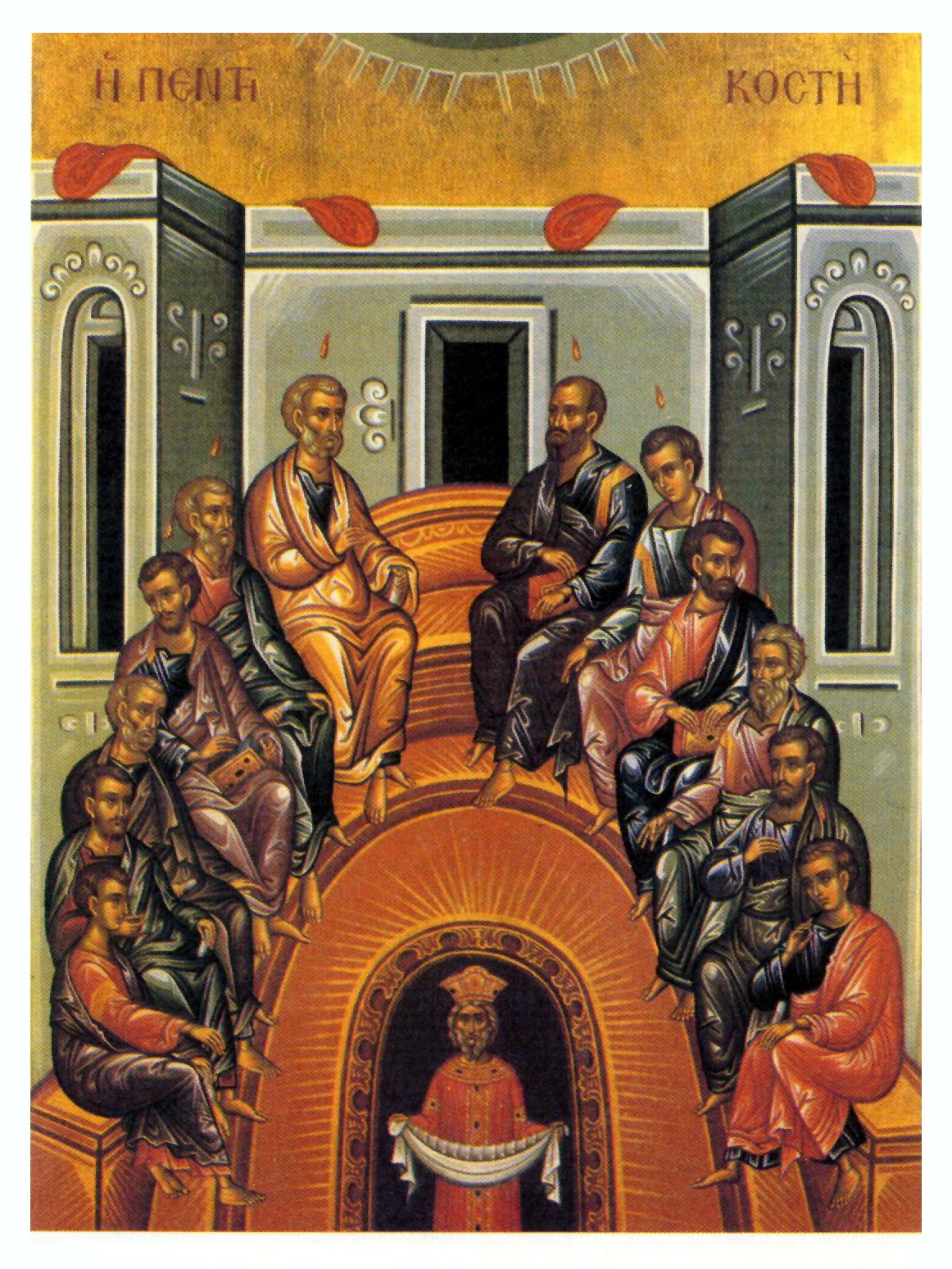
Celebrating Pentecost Sunday


Tomorrow is Pentecost Sunday, the birthday of the Church! The color red celebrates when the Holy Spirit came down on the Apostles in tongues of fire. Will you and your family be wearing red to church?

Another traditional symbol for the Holy Spirit is the dove. I was browsing through some vintage dove brooches on Etsy (for example, see here, here, and here), but I didn’t get one ordered in time for tomorrow. Maybe I will still buy one to wear next year.

For a while now, I’ve had an idea in my mind of a “Pentecost cake.” Of course, it didn’t turn out as perfectly as I had imagined, but I hope to improve on it every year. To imitate flames, I wanted to drizzle the colors on the cake. However, I wanted frosting, not glaze. So I purchased a container of frosting and briefly heated it in the microwave. I was able to drizzle the frosting while it was warm, and then it returned to its normal consistency after it cooled. The cake is topped with a little dove, sitting nestled among some strawberries.


I also think that lighting sparklers would be a fun Pentecost tradition for when our kids are a little older. Do you have any special ideas for celebrating Pentecost with your family?

Thursday, June 2, 2011

Happy Ascension Day


Today is Ascension Day. Taking our cue from Jessica, we’ll be heading to a nearby park and picnicking on top of the hill for dinner tonight.

Almighty God, whose blessed Son our Savior Jesus Christ ascended far above all heavens that he might fill all things: Mercifully give us faith to perceive that, according to his promise, he abides with his Church on earth, even to the end of the ages...Amen.

Thursday, May 19, 2011

Easter Centerpiece


This is the Easter centerpiece that I made this year. A great thing about celebrating Easter as an Anglican is that you can keep your Easter decorations up for fifty days! (Easter season is the period of fifty days from Easter Sunday to Pentecost Sunday.)

Wednesday, May 18, 2011

The Spiraling Adventure of the Spiritual Life

Wow. Joan Chittiser is such a good writer. I’ve really enjoyed her book The Liturgical Year. And if the title sounds a little bland, allow me to add the subtitle: The Spiraling Adventure of the Spiritual Life. The phrase has been bouncing around in my head for a while now. I love Chittiser's use of language. Usually the word “spiral” is paired with the word “downward.” But the subtitle of this book evokes the image of an upward spiral--a gradual ascent to holiness. Here are some quotes that I've enjoyed...

“The liturgical year is an adventure in bringing the Christian life to fullness, the heart to alert, the soul to focus. It does not concern itself with the questions of how to make a living. It concerns itself with the questions of how to make a life” (page 4, emphasis added).

“The liturgical year is the year that sets out to attune the life of the Christian to the life of Jesus, the Christ. It proposes, year after year, to immerse us over and over again into the sense and substance of the Christian life, until, eventually, we become what we say we are--followers of Jesus all the way to the heart of God. The liturgical year is an adventure in human growth, an exercise in human ripening.” (page 6, emphasis added)

“The liturgical year is the process of slow, sure immersion in the life of Christ that, in the end, claims us, too, as heralds of that life ourselves” (page 13).

“Liturgical time is the arc that affixes the layers of life. It binds heaven and earth into one and the same rhythm. Rather than give ourselves totally to life as we know it here and now, liturgical time raises our sights above the dailiness of life to the essence of life” (page 39, emphasis added).

Saturday, April 23, 2011

Easter Bells for the Great Noise

Our twins are going to be baptized at the Easter Vigil, so we will have family attending the service with us this evening. I want to make sure everyone is well-equipped with bells for the Great Noise. I stopped by Goodwill, and here’s what I found...


I didn’t want the colored bells to look too Christmasy, so I gave them a quick coat of spray paint. I sprayed the larger bells while I was it...those oldfashioned bells are sweet, but they aren’t really my thing. My apologies to anyone who collects them. Then I attached the small bells to some sticks, and here is my finished project...


Much better. And much more fun than cleaning the kitchen while everyone is napping!

Thursday, April 21, 2011

Some Brief Anglican Reflections on Holy Week

A few days ago my husband said, “I saw someone with a ‘He Is Risen’ sign on their door already.” I realize this person is not in the minority. I also grew up celebrating Easter in the weeks leading up to Easter Sunday, rather than the weeks following Easter Sunday. But resurrection can’t come unless it is preceded by death. And the Church must enter into the sorrow of death in order to appreciate the joy of resurrection.

For this reason, the Church observes Lent. On Sundays during Lent, we refrain from saying “Alleluia” at the usual spots during the service. This is because we are waiting for the Great Alleluia, after which the congregation is encouraged to ring the bells they have brought for the Great Noise.

How often do we want to skip the sorrow and head straight to the joy? We want to get to the good stuff as fast as we can. But we must wait. We must join Thomas in saying, “Let us also go, that we may die with him” (John 11:16). Because with Jesus, death is always followed by resurrection.

Wednesday, April 20, 2011

Quick, Easy Easter Craft

This little Easter project is perfect for kids or adults! These eggs will look lovely displayed on Easter morning on a bed of moss or in a pretty dish.


Tuesday, April 19, 2011

Our Easter Menu


I’m getting excited already! We’ll be having...


Wednesday, April 13, 2011

Vegetarian Recipe: Rockin Moroccan Stew

{Photo from here.}

Our vegetarian-friend introduced this stew to us a few months ago. I made it this week and was reminded of how delicious it is! Even my husband, who is usually picky about sweet potatoes, loves this meal. It’s a great Lenten recipe to try during these last days of Lent...

Rockin Moroccan Stew
Ingredients
2 tsp olive oil
1 cup chopped onions
1/2 cup each diced celery and chipped green bell pepper
1 clove garlic, minced
3 cups vegetable broth
3 cups peeled, cubed sweet potatoes
1 can (14-½ oz) tomatoes, drained and cut up
1 can (15 oz) chickpeas, drained and rinsed
1 Tbsp lemon juice
2 tsp grated gingerroot
1 tsp ground cumin
1 tsp curry powder
1 tsp ground coriander
1 tsp chili powder
1/2 tsp salt
1/4 tsp black pepper
1/4 cup raisins
2 tbsp light peanut butter
2 tbsp chopped, fresh cilantro

Directions
Heat olive oil in a large, non-stick saucepan over medium-high heat. Add onions, celery, green pepper, and garlic. Cook and stir until vegetables begin to soften, about 5 minutes. 

Add all remaining ingredients, except raisins, peanut butter, and cilantro. Bring to a boil. Reduce heat to low and simmer, covered, for 20 minutes. 

Stir in raisins, peanut butter, and cilantro. Mix well. Simmer for 5 more minutes. Serve hot.

I omitted the raisins because I didn’t have them. Also, I doubled the amount of peanut butter and cilantro, and if you like these flavors, then I recommend doing this! This stew tastes wonderful served over brown rice.

Monday, March 28, 2011

Sharing the Feast of the Annunciation with Little Ones


Friday was the Feast of the Annunciation. On this day the Church celebrates the angel Gabriel’s announcement to Mary that she would give birth to a son.  The Holy Spirit overshadowed the humble virgin, and she conceived our Lord.

I asked my husband why this feast takes place during Lent. It seems to be a little out of place within the church calendar. The reason is simple. The Church celebrates the Feast of the Annunciation on March 25 because it is exactly nine months before December 25, the day when it celebrates Jesus’ birth. Advent is the season of expectation, but every mother knows that the eager expectation begins the moment you  discover that there is life in your womb! How wonderful that the Church recognizes this and allows the excitement to begin building even now.

My husband and I hope to bring our children into the rhythm of the church year in creative and age-appropriate ways. They are still very young, but we discussed ideas for how we could celebrate the Feast of the Annunciation with our children a couple years from now. We think that doing a pro-life related activity would be an appropriate way to honor the conception of Jesus. So we found this list of ideas on the internet:
  • Donate money to a crisis pregnancy center.
  • Donate your unwanted maternity clothing or baby items.
  • Organize a baby food and diaper drive at your church.
  • Volunteer to watch children at the local center.
  • Open your home to a pregnant woman for the duration of her pregnancy and aftercare.
  • Offer to pay for an expectant mother’s medical care.
  • Drive a pregnant woman to her prenatal appointments.
  • Pay for a crisis pregnancy center ad in the Sunday newspaper.

Thursday, February 26, 2009

Ash Wednesday Reflections

{"The Expulsion" by Janice Williams Whiting}

I won’t be surprised if I always remember last night. As I mentioned earlier, it was my first time attending an Ash Wednesday service. I had read the Ash Wednesday liturgy the morning before, but there was something entirely different about participating in it. The words of the liturgy weighed heavily upon me and sank deeply in.

“I invite you, therefore, in the name of the Church, to the observance of a holy Lent, by self-examination and repentance; by prayer, fasting, and self-denial; and by reading and meditating on God's holy Word.”

In the name of the Church. That phrase struck me. By observing a holy Lent, I am uniting myself with the Church – past, present, and future. Some might say, “But Lent isn’t prescribed in Scripture.” No, but the Church, in her wisdom, call us into it. Furthermore, the acts self-examination, repentance, prayer, fasting, self-denial, and meditating certainly are prescribed in Scripture.

“To make a right beginning of repentance, and as a mark of our mortal nature, let us now kneel before the Lord, our maker and redeemer.”

The right beginning of repentance always takes place on our knees.

“…Grant that these ashes may be a sign of our mortality and penitence, that we may remember that it is only by your gracious gift that we are given everlasting life, through Jesus Christ our Savior.”

The ashes signify two things – our mortality and our penitence. Our frailty and our failures. That we are dust, and that we are penitent just like those who would mourn in sackcloth and ashes.

Remember that you are dust, and to dust you shall return.

Wednesday, February 25, 2009

Lent Begins With Ash Wednesday

My husband and I joined the Anglican Church last year in the middle of the season of Lent, so we have never attended an Ash Wednesday service. Perhaps that’s why I identify so much with the following passage from Ancient Future Time. Robert Webber’s explanation of Ash Wednesday especially addresses those who are new to liturgical worship. He writes:

“Unfortunately some Christians live as though the death and resurrection of Jesus Christ never happened. Our lives become absorbed in the day-to-day experiences of life. We focus on name-brand clothing, the color of our houses, the size of our bank account...We too easily forget our Maker and Redeemer, replacing God with things and ambition. Lent is the season that does something about this situation. It calls us back to God, back to basics, back to the spiritual realities of life. It calls on us to put to death the sin and the indifference we have in our hearts toward God and our fellow persons. And it beckons us to enter once again into the joy of the Lord--the joy of a new life born out of a death to the old life. This is what Ash Wednesday is all about--the fundamental change of life required of those who would die with Jesus and be raised to a new life in him.

For most people coming from my background, an Ash Wednesday service and Lent are quite foreign and somewhat threatening. The Christmas and Advent cycle are much less threatening because Christmas themes are so prevalent in our culture...But Lent is another matter. Lent appears to be dark and foreboding. It reminds Protestants of their worst fears of Roman Catholic practices--ritualism, works, fasting, vigils, and the like. Haven't we been saved from all that (we ask)? Didn't the Reformers free us from having to do works and pilgrimages and such things?

…Perhaps we laughed inside and thought to ourselves, just another mark of an external, ritualistic religion. Perhaps yes, perhaps no. Only God can judge the heart. Aside from that, dare we ask: Does something lie behind that symbol that has the potential to make our journey into Easter more meaningful? After all, what do we do for Easter? Most Protestants don't make any spiritual preparation for the annual celebration of the death and resurrection. For example, when I was growing up the only preparation for Easter made in my home--a deeply committed Christian home at that--was the planning and purchasing of new clothing. Easter was a weekend event. Preparing for Easter for seven weeks was unthinkable, ludicrous, even pagan.

But now I am constrained to ask: Who is the pagan? Yes, it is wrong to go through the motions of Ash Wednesday and Lent in a mechanical, uninvolved way. But it is also wrong to ignore any kind of preparation for the Easter event…We can begin the journey of Lent by the life-changing content of the Ash Wednesday service.”

Robert Webber, Ancient-Future Time: Forming Spirituality through the Christian Year, (Grand Rapids: Baker Books, 2004) 99-100.

Wednesday, November 19, 2008

The Calendar of the Christian Pilgrim

{"Little Miss Sunshine" by Robert David Bretz, print available on Etsy }

Jessica Snell, a writer who I blogged about here, has a great post on Advent. I especially appreciate this sentence:

“When you see the year not just as winter, spring, summer, and fall, but as Advent, Christmas, Epiphany, Lent, Easter, Pentecost, and Ordinary Time, then the changing seasons don't just remind you that the Earth is circling the Sun, but that God Himself came down onto that Earth in order to save us all.”

Christians are called to be pilgrims, seeking a better country. I love how the church year provides a framework in which to understand the idea of Christian pilgrimage. The world is not our home, and the liturgical calendar provides the Christian with a way to mark time. It reminds us of our heavenward journey, and it directs our gaze towards the place to which we are heading. More on Advent here.

Monday, November 3, 2008

Advent: Coming Back Around to What Is True

Many Christian traditions celebrate Advent and Easter, yet they have abandoned the rest of the church calendar. I am learning how Advent and Easter fit into a bigger picture. Beginning with Advent, the liturgical calendar traces the events of Christ’s life and conforms our lives to his. In the rhythm of the church year, our lives become hid with Christ. We find our life in his life. His story becomes our story. Why participate in this ordering rhythm throughout the year? Here is Thomas Howard's explanation in The Liturgy Explained:

“The idea in all of this is the same as in all human celebrations and anniversaries: it is a good thing for us mortal creatures to be vividly reminded at regular intervals of something that is always true anyway (a marriage, a birth). It helps us. It freshens our imagination. Perhaps angels experience an eternal, perfectly clear, sameness of awareness. We cannot. We have to keep coming back around to what is true.”


As we approach Advent and come back around to the truth of Christ’s birth, we are called to prepare our hearts for the coming of God to us – not only in his Nativity, but also in his Second Coming.

[Quote from Howard, Thomas and Betsy Corwin. The Liturgy Explained. Wilton, Conn: Morehouse-Barlow, 1981 (37).]

LinkWithin

Related Posts Plugin for WordPress, Blogger...